This article reflects the opinion and analysis as well as information collated by AE Research Management Sdn Bhd, and does not constitute an investment advice or recommendation
The ultimate objective of US tariff policies is to revive its manufacturing industries which has hollowed out from decades of offshoring to cheaper locations. The strongest push comes from Section 232 tariffs that are invoked on national security grounds to protect specific industries. Since March 2025, US has imposed hefty 50% tariffs on steel and aluminum imports in order to protect and expand the domestic metal industries. These tariffs covered the metal content of derivative products as well – for example, parts such as machinery blades are also subjected to a 50% tariff on its steel content.
Recently (on 2nd April 2026), the US government made some fine-tunings to the tariff framework, whereby tariff on metal derivatives is lowered to 25% but will now be imposed on the full value of the products (as paid by importers) – this will simplify the regime and plug understating loopholes. Simultaneously, the tariff on imported metalworking machines will be reduced to 15% through 2027, to encourage industrial capex.
It is clear that US is resolute to boost re-shoring of the metal industries. Not only will US primary steel-making output be expanded, there will also be an increase in metalworking operations within the US – it simply does not make sense to export the steel plates/coils output to another country to be machined and then re-exported back to the US! Indeed, many auto manufacturers have decided to move more production to the US since it is clear that the Trump administration will not waver on the Section 232.
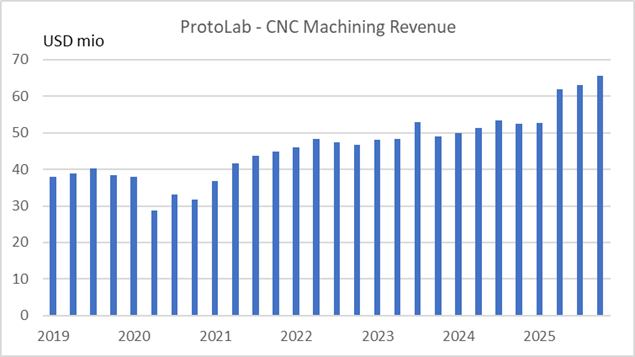
There are encouraging lead indicators of this megatrend, for example in the machining revenue of ProtoLabs Inc, a US company specializing in machining of prototypes, ie before the roll out of mass production, which saw a step jump since 2Q25.
ProtoLabs Inc – CNC Machining Revenue
Source: Company reports
Huge Opportunity for Advanced Machine Tool Makers
Metal machining is the backbone of the energy & defense industry and therefore vital for national security. More generally, metal machining capabilities is core to the revival of manufacturing activities in the US across broad range of industries from automotive/parts, medical devices to consumer products like baby strollers and washing machines.
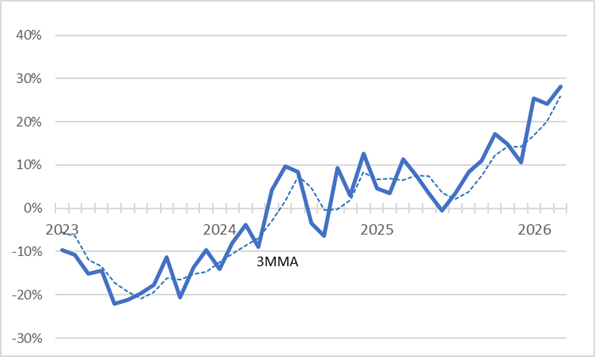
Orders Received (% YOY) by Japanese Machine Tools Builders
Source: Japan Machine Tools Builders Association
Orders received globally by Japanese machine tool builders such as DMG Mori, Okuma and Makino, have been gaining momentum (chart above). There have also been indications of active discussion with US customers for projects extending to 2028.
As it currently stands, the installed base of machine tools globally is very old, most aged being in the US where most machine tools are 40-50 years old. Machining shops in US have also suffered dwindled number of machinists as workers retire.
With this backdrop, it is inevitable that a revival of machine tools demand in US will comprise a rich mix of highly-integrated and automated systems, which can enable machine shop operators to just focus on programming control, and let the machining process be carried out 24/7 by robots integrated into the machining system.
Machining technology has made quantum progress over the past 10-15 years. First was the launch of mill-turn centers, accommodating both the features of a milling and a turning machine. This was followed by the introduction of the 5-axis machines, one of the most complex yet versatile tools. In addition to the conventional 3D XYZ-axis motions, two rotational spindles are added – around the x-axis and y-axis, i.e., the machine can manipulate the workpiece in any constellation, to enable production of even the most complex shapes.
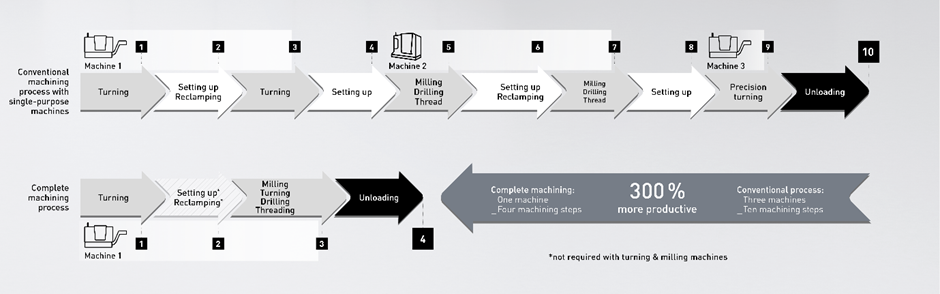
For example, with an extensive library of more than a thousand interchangeable tool heads, a single 5-axis machine is able to combine 3-4 processes such as milling, turning, drilling, and threading into one single operation without constant re-clamping, resulting in increased productivity with minimal rooms for error (see graphics from DMG Mori below)
Quantum Increase in Productivity with Advanced Machine Tools
Source: DMG MORI
Since the mid-2010s, leading machine tool makers have also started to offer integrated or turnkey solutions. The solutions integrate advanced machines tools with peripheral equipment such as robots, pallet changers, tool loaders and on-line measuring devices, to enable a fully autonomous process. Such integrated systems require upgraded operating & control software to enable easy programming of the desired applications. Looking into the near future, additive manufacturing (3-D printing) can also be added to a 5-axis machining system as one of the modules, expanding the possibilities of metalworking that has traditionally been subtractive process for over a century.
In short, recent technological advancements have made available metalworking solutions that require very little labor, reduce factory footprint and energy consumption – a tremendous boost to efficiency.